


Your browser is out of date.

You are currently using Internet Explorer 7/8/9, which is not supported by our site. For the best experience, please use one of the latest browsers.

This Course Has Been Replaced

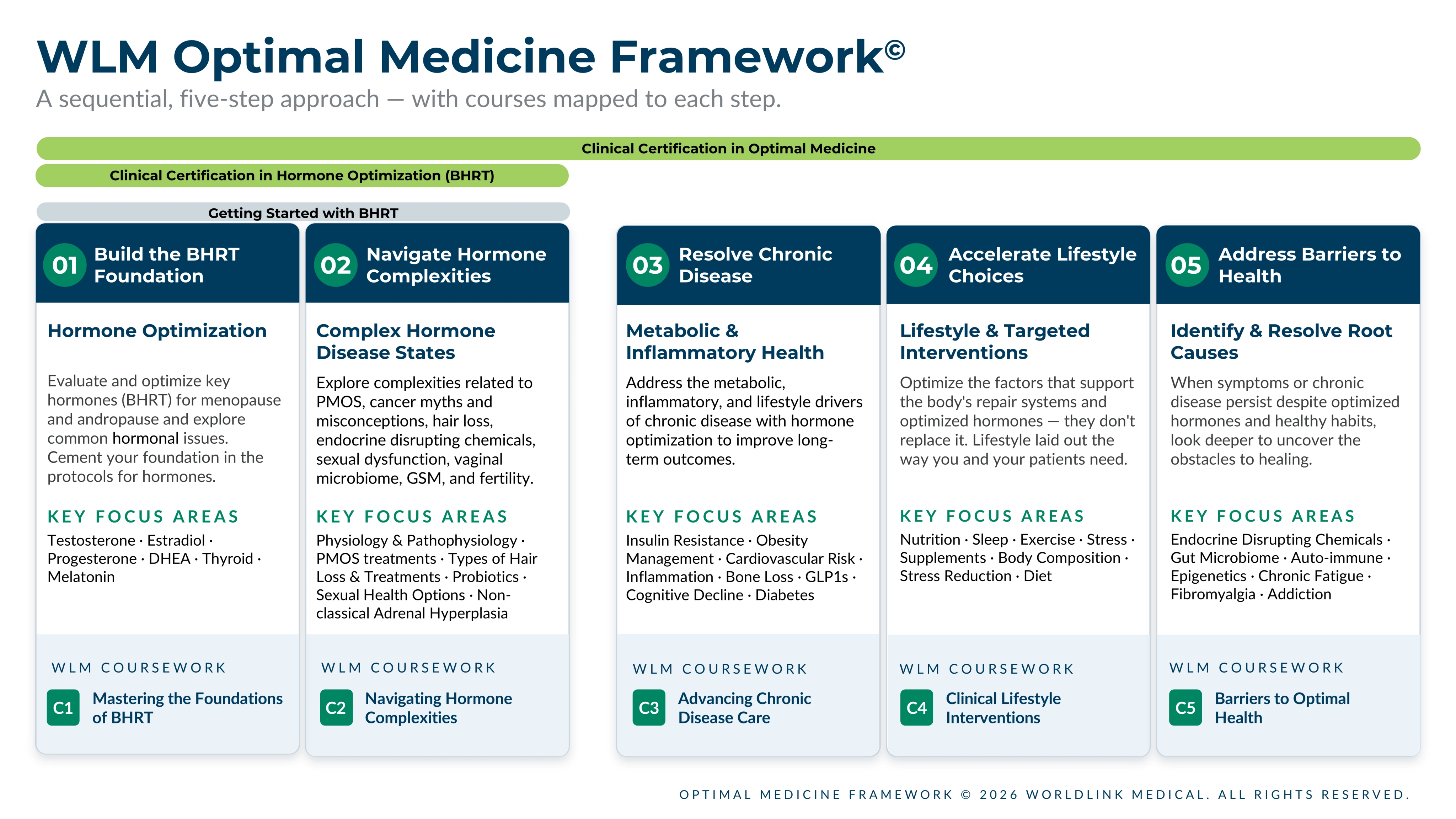
The Legacy BHRT courses have been replaced with the Optimal Medicine Training Series.

Worldlink Medical will continue to teach evidence-based BHRT courses, now updated and expanded to include Optimal Medicine: a structured pathway that includes hormone therapy,  lifestyle medicine, nutrition, gut health, sleep, exercise, and root cause diagnostics.

Explore Courses
Mastering the Protocols for Optimization of Hormone Therapy

BHRT Part 4: Mastering the Practice

June 5-7, 2026 • Pre-Recorded Presentation with Live Q&A• Recordings available 60 days post event

There are new articles, research, updates, literature critiques, and sarcasm (of course) presented in our hormone optimization therapy BHRT Workshop Series, Part IV. It is the last in the series and should be the final preparation for certification in the series.

Register Now

Details

Course Description

Prerequisites:

Recommended Prerequisites: 

There are new articles, research, updates, literature critiques, and sarcasm (of course) presented in our hormone optimization therapy BHRT Workshop Series, Part IV. It is the last in the series and should be the final preparation for certification in the series 

The workshop will involve several components, including reviewing the latest NAMS recommendations. The medical literature will be used to support decision making rather than sole reliance on the WHI trial. Some of the exciting topics to be discussed include:

  • Treatments for common gynecological issues (severe PMS, migraines, endometriosis, and abnormal bleeding, such as heavy bleeding, irregular menses, etc.)
  • TBIs and Hypopituitarism – diagnosis and treatment
  • Advanced prostate cancer treatment protocols (i.e – BAT therapy, proton gun, external beam radiation, etc.)
  • Alternative treatments for vaginal atrophy and orgasmic disorders in women (testosterone, oxytocin, etc.)
  • Male orgasmic disorders and treatments (topical testosterone applied to the glans of the penis, oxytocin spray, etc.)

The workshop will also provide an in-depth review of the evolution of opinion on testosterone replacement therapy, from the belief that it causes prostate cancer to its role in possibly protecting against cancer and how it may even be used to treat active cancer in some men and women.

Accreditation
  • 20 AMA PRA Category 1 Credits
  • 20 Nursing Contact Hours 

BHRT Part IV Overview

Access: This training is offered both in-person and virtually. Educational materials and the syllabus will be provided online. A recording of each day’s session will be posted that same evening and remain available up until 2 weeks after the event for you to re-watch or catch up on any missed content. Recordings will not be accessible after that time.

Accreditation: 20 AMA PRA Category 1 Credits | 20 Nursing Contact Hours | 20 Hours Pharmacy Credit (knowledge based)

Learn More about the BHRT Workshop Series

Learn More

Course Objectives

Upon completion of this workshop the health care professional will be able to:

  • Review prognosis and complications for radical prostatectomy, proton gun radiation therapy, brachytherapy, cryotherapy, HIFU, laser ablation, as well as associated costs.
  • Review management strategies and importance of testosterone utilization in prostate cancer survivors as well as literature support, in addition to the various mechanisms of estrogen's ability to top prostate cancer growth.
  • Evaluate the association of testosterone and estradiol levels and the risk of developing prostate cancer. Should we raise, block, or administer estrogen based on the literature?
  • Recognize that optimal thyroid levels are best as recent studies determine that high TSH levels are associated with increased arterial stiffness and plaque thereby increasing CVD risk.
  • Review studies that show testosterone administration is protective agains breast cancer and is apoptotic to cancer cells. Demonstrate that assiciation does not prove causation and one should not extrapolate them to be the same.
  • Demonstrate through literature review, how estrogen administration in men protects agains heart disease and prostate cancer.
  • Evaluate and discuss Dr. Neal Rouzier’s 50 most difficult management cases involving HRT, in addition to evaluating abnormal lab tests and various symptoms in complex and confusing cases.
  • Identify current approaches to managing vaginal bleeding, DUB, and endometrial hyperplasia..
  • Identify how Traumatic Brain Injury (TBI) affects quality of life by causing pituitary dysfunction. .
  • Evaluate recent literature demonstrating the mechanism by which synthetic progestins increase breast cancer development through the production of the RANKL protein.
  • Utilize dual intravaginal therapy to maximize the effect on atrophic vaginitis, chronic UTI, incontinence, and sexual dysfunction, as well as how to treat the vagina with pills, patches, ring and things.
  • Evaluate when to use estrogen in premenopausal women and when not to use it: 
  • Identify different types of estrogen and progesterone and when to prescribe each.
  • Review various scenarios that dictate when to switch to alternate forms of HRT based on patient history, BMI risks, and compliance.
  • Discuss hair loss in women: Current approache to reverse hair loss.
  • Describe various delivery forms in testosterone administration in women.
  • Discuss the current approach to preventing CVD in women with Syndrome W (X).
  • Discuss HRT review, myths, updates, and alternatives when the usual routine is doesn't work and eview management strategies for estrogen intolerance and progesterone intolerance.
  • Identify current recommendations from NAMS for HRT and ERT and how they differ from past recommendations.
  • Review the history as to why the world believes testosterone causes prostate cancer.
  • Review further data demonstrating that E2 is the best estrogen but not the safest.

Agenda

7:30 am MTLive Stream access opens
8:00 am - 12:00 pm MT5-10 minute break at the top of every hour
Section A
  • Appreciate a literature review of which type of estrogen to use in which circumstances and why. Oral vs transdermal, risks vs. benefits, and recent NIH studies.
  • Evaluate the most important literature summary chapter on estrogen and progesterone that you will ever read proving the harm of estrogen deprivation and the benefit of replacement = a must for everyone’s library.
  • Review all the long-term studies demonstrating the effect of estrogen on morbidity and mortality and the pathophysiology behind it all.
  • Determine how to assess studies of association that do not prove causation in contrast to RCT’s that prove causation through interventional study.
  • Do not extrapolate to prove a theory as one must intervene to prove causality.
Section B: Estrogen in men: Good, bad, or indifferent?
  • Review the studies demonstrating estrogen is associated with an increased risk of heart disease and cancer in women as well as heart disease in men = an association.
  • Review the extensive literature on the beneficial effect of estrogen in men in the treatment and prevention of prostate cancer and heart disease = proves benefit = causation.
  • Understand the various methods for raising estrogen in men and consequences of each.
  • Evaluating the literature and understanding the difference between cause and effect and how it pertains to hormones.
  • Discuss how association does not prove causation and to prove this requires the need for RCT’s to differentiate.
  • Practice HRT according to the EBM and not confabulation = don’t lower estrogen.
  • Learn how to decrease visceral fat, increase libido, increase lipids, and decrease dementia through aromatase inhibitors as per NEJM.
12:00 - 1:00 pm MTLunch
1:00 - 6:00 pm MTSection C: Review the historical perspective of testosterone causing prostate CA or how easily we can be led astray.
  • Understand how Huggins was correct in his assumption but also very wrong in his conclusion. Huggins led us astray with just one patient!
  • What level of testosterone is conducive to the growth of prostate cancer?
  • What level of testosterone is safest to maintain for prostate cancer protection?
  • Is it possible or safe to utilize testosterone in prostate cancer survivors and at what point in time?
  • Using testosterone in men with active cancer? What does the literature support and under what circumstances.
  • Understand the complexity of the saturation model that is demonstrated in the world’s literature.
  • Does testosterone cause prostate cancer or does it not? Well it depends. Yes it does but treatment does not, rather endogenous does but exogenous does not.
  • Review of the meta-analysis and world’s expert opinions.
Section D: Estrogen – What happens when we block, lose it, replace it?
  • NAMS Recommendations and Commentary on Risks, Benefits, Side Effects, Problems, Complications, Indications, and Contraindications of HRT.
  • Pearls that you should know but don’t.
7:30 am MTLive Stream access opens
8:00 am - 12:00 pm MTSection E: Genito-urinary Syndrome of Menopause (GSM)
  • Alternative treatments for vaginal atrophy.
  • Treatment for orgasmic disorders.
Section F: The Harm of Estrogen Deprivation in Men
  • Estrogen’s Effects on Lipids in Men.
  • Physiologic Effect of Low Estrogen in Men.
  • State of the Art Treatment for Prostate Cancer.
  • More Studies on Harm of Blocking Estrogen in Men.
Section G: Discuss new insights into thyroid hormone replacement.
  • Discuss use of T3 alone and what it does to lab values.
  • Review the studies demonstrating genetics (DIO2 gene) predict response to T3 that explains the wide range of responsiveness.
  • Discuss the plethora of data from pharmaceutical studies that prove that T3 is worthless and not needed.
  • Explain how to design a study to prove that T3 does not work.
  • Discuss why athyreotic patients don’t do well on T4.
  • Thyroid for ED?
  • Review the recent Medco advisory to stop Armour thyroid.
12:00 - 1:00 pm MTLunch
1:00 - 6:00 pm MTSection H: Vaginal Bleeding Work-up and Treatment
  • The Most Common Problem, Issue, Complication, Headache, and PITA Side Effect in Treating Women with HRT
  • Vaginal Bleeding, Work-up and Treatment
  • Cases of Vaginal Bleed with Lab Review
  • Don’t Fear It
  • Don’t Forget the Informed Consent
Section I:
  • Estrogen vs. Statins vs. ASA for CVD Protection
  • Relative Risk of Breast Cancer for Estrogen, Progesterone, and MPA
  • Traumatic Brain Injury
Section J: Real Concerns and False Alarms of HRT
7:30 am MTLive Stream access opens
8:00 am - 12:00 pm MTSection K: 50 complex cases, treatment and management.
12:00 pm MTAdjourn

***
Sections 1- 7 are provided for your review in the digital version of the educational material, answers are provided so please use this as a review tool to test your understanding of the information

In support of improving patient care, this activity has been planned and implemented by The Foundation for Care Management (FCM) and Worldlink Medical. FCM is jointly accredited by the Accreditation Council for Continuing Medical Education (ACCME), the Accreditation Council for Pharmacy Education (ACPE), and the American Nurses Credentialing Center (ANCC), to provide continuing education for the healthcare team

20 AMA PRA Category 1 for CME

20 Nursing Contact Hours

20 Contact hours Pharmacy Credit. Program # UAN JA0007163-9999-25-016-L01-P

This activity was planned by and for the healthcare team, and learners will receive (20 hours) Interprofessional Continuing Education (IPCE) credit for learning and change.

Pricing

Invest in your hormone therapy education with thoughtful pricing designed for different providers types:

  • Prescribers: $1,695

This rate applies to licensed medical professionals who prescribe hormone therapy.

 Applicable Credentials: MD, DO, PA, NP, ND


  • Non-Prescribers & Graduates: $1095

Ideal for clinical support staff, students, and BHRT Series alumni seeking to refresh their knowledge.

Applicable Credentials: MA, RN, RPh, Resident / Intern, Pharmacist, Office Manager, Dietician, Nutritionist, Health Coach


The course material is the same for both provider types. Whether you're expanding your clinical expertise or supporting patient care, the BHRT Series offers exceptional value and evidence-based training. 

Policies

Refund / Cancellations / Bulk Discounts / Course Credit

Early bird discount ($100.00 savings) is available up until 3 weeks prior to the event.  This discount does not need a code but is applied automatically.

Up to 3 weeks prior to the course start date the cancellation fee is $100.00.  If a cancellation is requested less than 3 weeks in advance the cancellation fee is $350.00. If a cancellation is received within two weeks of the event there are no refunds allowed.

To cancel a registration, a credit can be held on file without penalty so long as the cancellation is received more than 2 weeks in advance of the start date.  This credit will be applied automatically to your next registration before a credit card is charged.

If two or more prescribers register as a group under one registration ticket there will be a 10% discount applied to each registration after the first one.

Dates:
June 5-7, 2026 Virtual $595 - $1095 Register Now